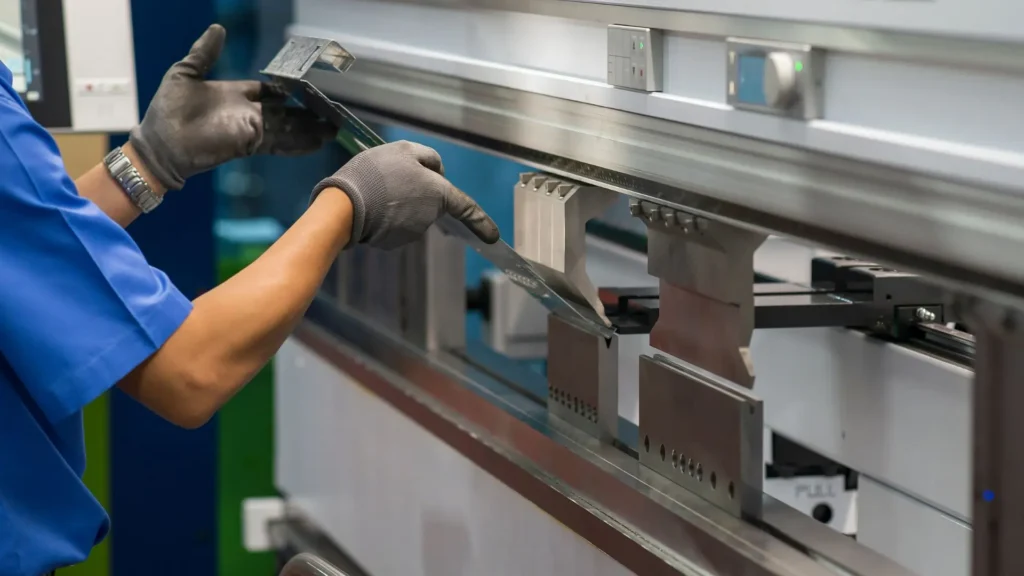
How does a press brake work, and why is it one of the most important machines in the metalworking industry? With the rapid development of CNC technology, understanding how a press brake works becomes increasingly essential for companies seeking precision, speed, and efficiency in sheet metal processing.
In this article, we explain the working principle of press brakes, discuss their types and applications, and outline the key factors to consider when choosing the right machine. If you want to better understand how a CNC press brake influences both mass and custom production — you’re in the right place.
What Is a Press Brake?
A press brake is a specialized machine used in the process of bending sheet metal, which consists of permanently deforming the material along a designated line. Thanks to high pressing force and precise control of the bending beam’s movement, the machine enables the formation of very accurate angles and bends — essential in manufacturing steel structures, housings, and industrial components.
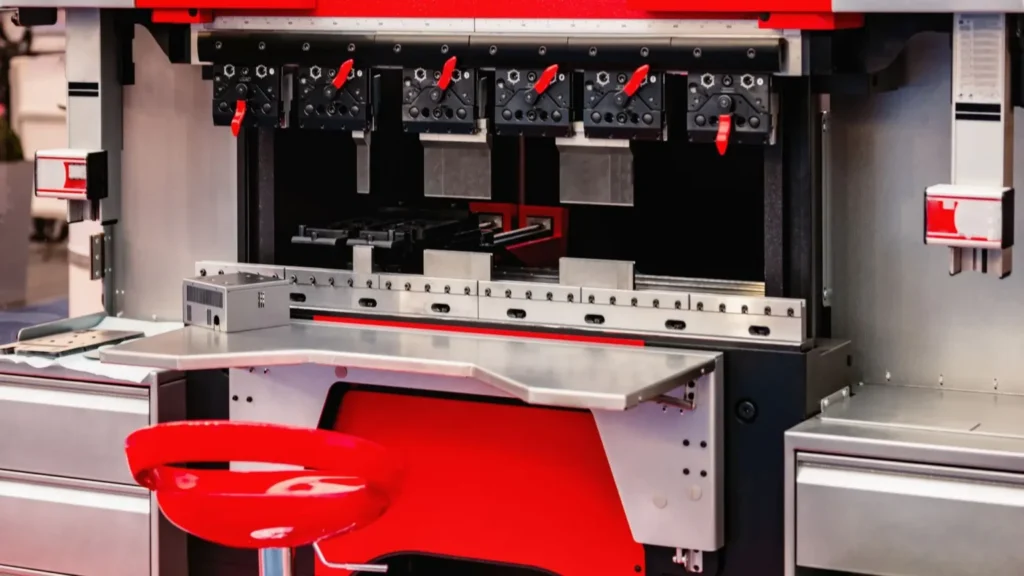
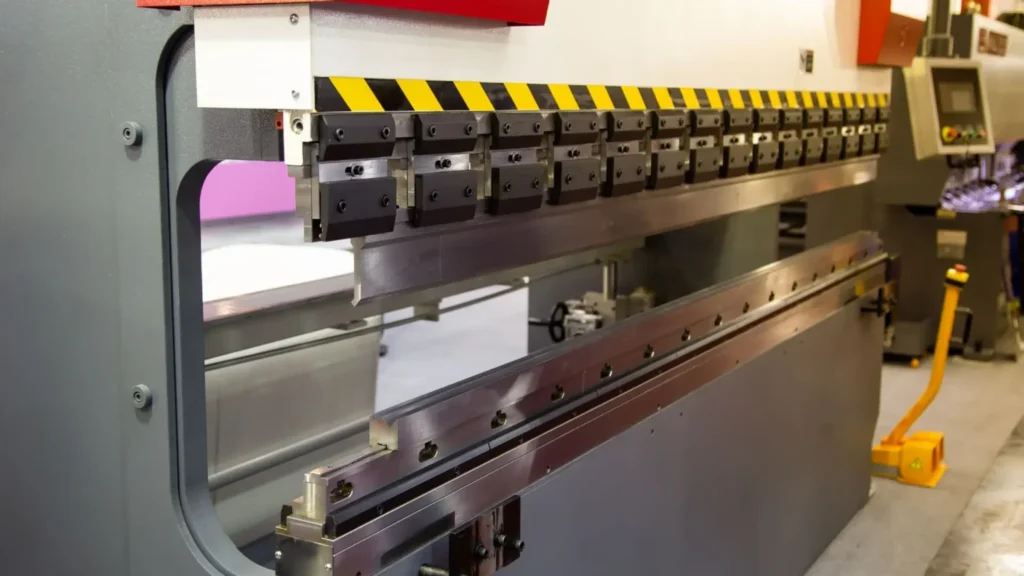
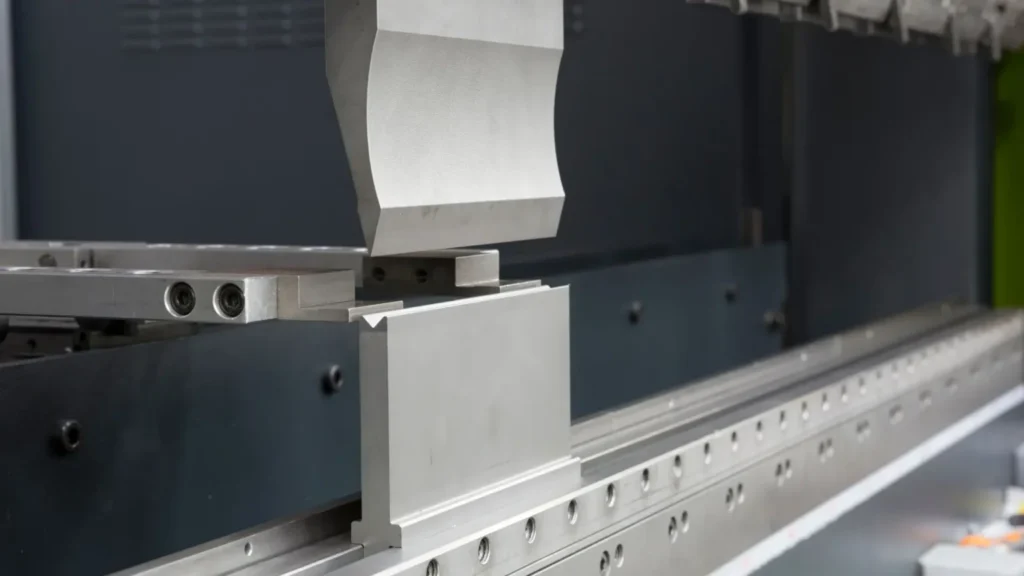
Construction of a Press Brake:
-
Upper beam (ram) – moves downward to perform the bend.
-
Worktable – supports the die and the sheet being processed.
-
Punch and die – responsible for shaping the bend.
-
Control system – fully digital in modern machines, such as CNC press brakes.
Role of the press brake in sheet metal processing:
Bending sheet metal on a press brake is a critical process in the production of many metal components — from control cabinets to machine parts and architectural panels. Proper machine setup ensures repeatable results with minimal dimensional deviation.
A CNC press brake additionally allows saving and repeating bending programs, significantly increasing production efficiency and quality.
How Does a Press Brake Work?
How does a press brake work? The question is best answered by understanding the basic mechanism of the machine. A press brake uses the force applied by the bending beam to the material placed on the die. This process permanently changes the shape of the sheet by controlled deformation.
Press brake operating principle:
-
Positioning the material – the sheet is placed on the die at the desired bending line.
-
Lowering the beam – the beam, driven mechanically, hydraulically, or by CNC servomotors, moves downward.
-
Contact with the material – the punch presses the sheet into the die, causing plastic deformation at the selected angle.
-
Cycle completion – the beam lifts, and the bent part is ready for further processing.
In modern machines such as CNC press brakes, the entire process is digitally controlled: the operator programs bending parameters, and the machine automatically adjusts force, beam positions, and working speed.
Precision bending through automation
Precision CNC bending enables complex multi-plane bends with very high dimensional accuracy. CNC systems also compensate for material springback, minimizing errors resulting from the sheet’s natural characteristics.
Types of Press Brakes
Today’s market offers various types of press brakes tailored to specific tasks, materials, and production volumes. Choosing the right technology has a direct impact on efficiency, precision, and production costs.
The most common types:
🔹 Mechanical Press Brakes
-
Driven mechanically via a flywheel.
-
Fast cycle times but limited pressure control.
-
Typically used for simple, repetitive bending operations.
🔹 Hydraulic Press Brakes
-
Use hydraulic cylinders to generate force.
-
Allow precise adjustment of force and speed.
-
Ideal for bending thicker sheets and parts with varying geometry.
🔹 Hybrid Press Brakes
-
Combine mechanical drive with the precision of hydraulic or electric systems.
-
Offer higher energy efficiency and faster response times.
🔹 CNC Press Brakes
-
The most advanced type, numerically controlled.
-
Automated bending enables quick setup of angles, positions, and forces via the controller.
-
Perfect for mass production and complex parts requiring high repeatability.
Why CNC?
A CNC press brake allows the execution of even the most complex bending projects with minimal operator involvement. With programmable and repeatable parameters, the machine achieves precision required by modern industry.
What Is a Press Brake Used For?
What is a press brake used for? Its primary purpose is bending sheet metal to achieve desired shapes — both in single-piece and series production. With precise angle and radius formation, the CNC press brake is indispensable across many industrial sectors.
Most common applications:
-
Control cabinet production – bending stainless steel panels and housings.
-
Machine and equipment enclosures – forming precise structural parts.
-
Steel profiles and sections – used in supporting structures and specialty frameworks.
-
Architectural panels and façades – forming decorative sheet metal elements.
-
Automotive and household equipment parts – production of housings, frames, and brackets from thin and medium-thick sheets.
Bending sheet metal on a press brake ensures high-quality edges, accurate dimensions, and clean aesthetics — crucial in both industrial and design-oriented applications.
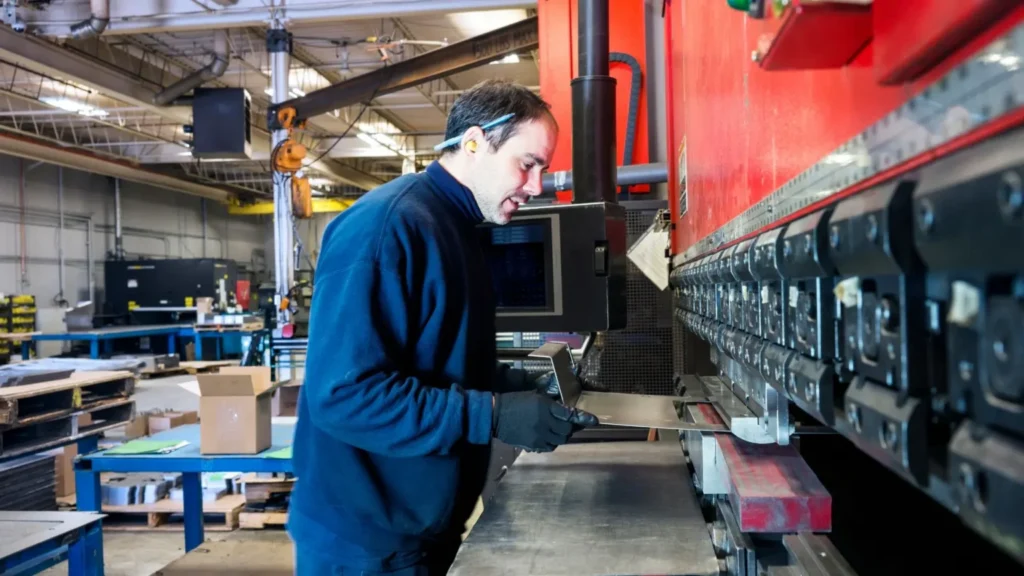
CNC Press Brake – Modern Sheet Metal Bending
Manufacturers increasingly invest in CNC press brakes, enabling full automation of the bending process. Precision CNC bending delivers consistent, high-quality components with minimal operator input.
Key benefits of CNC press brakes:
-
Precision – angle and position repeatability within tenths of a millimetre.
-
Automation – fast machine setup, programmable bending sequences.
-
High productivity – short cycle times ideal for serial production.
-
Reduced errors – minimal human-factor mistakes.
-
Ease of use – intuitive interfaces and compatibility with CAD/CAM.
Modern capabilities:
A modern press brake for serial production may include:
-
automatic sheet loading/unloading systems,
-
real-time angle measurement,
-
dynamic on-the-fly bending corrections.
This makes CNC bending technologies a standard across industries from automotive to aerospace and architecture.
How to Choose the Right Press Brake?
Selecting the right bending machine is crucial for production efficiency, part quality, and operating costs. When choosing a CNC press brake, consider these factors:
Key criteria:
🔹 Sheet thickness and length
These define the required pressing force (tonnage) and working width.
Thin sheets need low-tonnage machines; thicker ones require high-power presses.
🔹 Type of production: serial vs. single-piece
-
Mass production → fast changeovers, automation, 24/7 capability.
-
Custom production → flexibility and quick program adjustments.
🔹 Precision and automation
If tight tolerances matter, choose a CNC press brake with real-time angle measurement and dynamic corrections.
🔹 Material type
Different materials behave differently: stainless steel, aluminium, carbon steel — each requires appropriate tools and parameters.
Why modern technology?
Investing in CNC bending technologies boosts quality, efficiency, and adaptability to changing market needs.
Press Brake in Modern Industry
We’ve explained how a press brake works and what it is used for, highlighting its crucial role in sheet metal fabrication. From individual components to high-volume production, the CNC press brake is now a cornerstone of modern manufacturing.
Bending sheet metal on a press brake ensures:
-
higher productivity,
-
superior accuracy,
-
consistent quality — regardless of part complexity or production volume.
If you’re planning to expand your machine park or need a solution tailored to your production requirements, contact us. We’ll help you choose a press brake perfectly matched to your needs — from single projects to fully automated production lines.